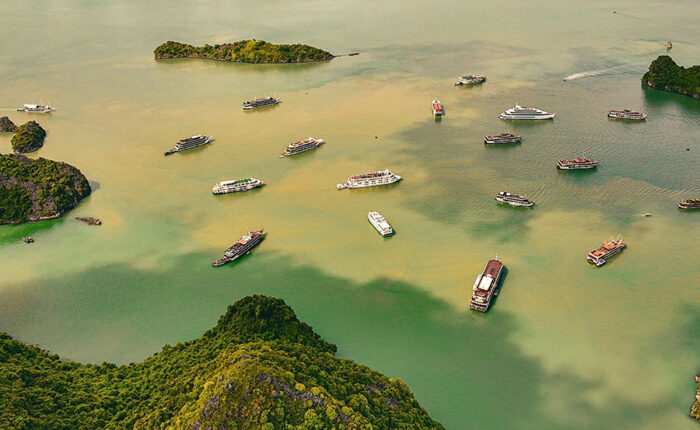
Black lady mountain (NUI BA DEN), it commonly known in English as Black Virgin Mountain, has long been regarded as one of the most significant spiritual and cultural landmarks in southern Vietnam. Rising approximately 986 meters above sea level, it is the highest mountain in southern Vietnam and is often described as the “roof of the Southern Region.”
The History of Caodaism in Vietnam and the Mysteries of the Holy See of Tay Ninh
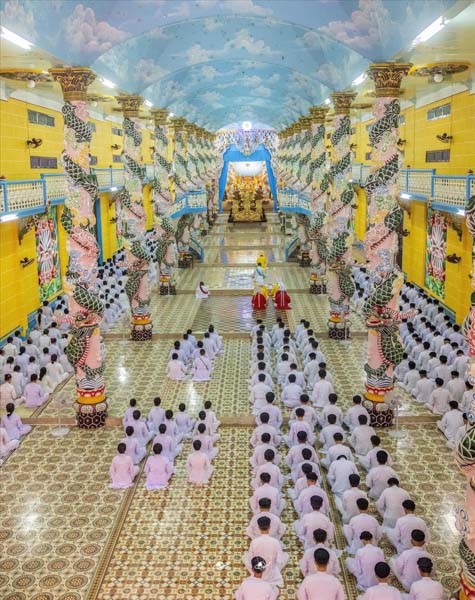
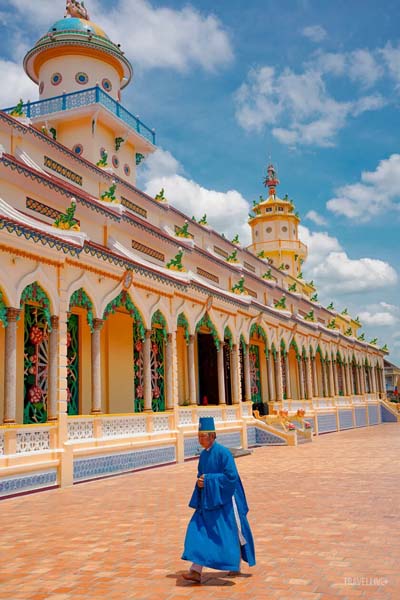
Cao Dai, formally known as Đại Đạo Tam Ky Pho Do “The Great Way of the Third Universal Salvation”, it is one of the most remarkable indigenous religions to emerge in modern Vietnam. Founded in southern Vietnam during the early twentieth century, Caodaism represents a highly sophisticated synthesis of Asian and Western religious traditions. Its spiritual and administrative centre, the Holy See of Tay Ninh
Cuchi Tunnels, The most famous historical places during the American War or Vietnam War (DIA DAO CU CHI)
Cu Chi Tunnels stand among the most remarkable military structures of the twentieth century. Located northwest of Ho Chi Minh City, the tunnel network became a symbol of endurance, ingenuity, and the sophisticated nature of Vietnamese guerrilla warfare during decades of conflict. The first tunnels began appearing around 1947, during the resistance against French colonial forces in southern Vietnam. Initially, villagers and local resistance fighters dug short underground shelters by hand using rudimentary tools. These early tunnels served as hiding places during military sweeps and surprise attacks. Over time, however, the system evolved into a vast underground network stretching for hundreds of kilometers beneath the countryside
The Black Lady Mountain
According to Vietnamese historical traditions, the cult surrounding Linh Sơn Thanh Mau, popularly known as the “Black Lady,” reflects the syncretic evolution of local spirituality in southern Vietnam. The narrative of a virtuous woman who was later deified corresponds to broader Southeast Asian patterns of female protective deities and sacred feminine cults. Over time, this local legend evolved into a major devotional tradition deeply integrated into the religious life of the region
From a Buddhist perspective, the mountain has become one of the most important pilgrimage centers in southern Vietnam. Sites such as Chua Ba Nui Ba Den attract millions of pilgrims annually, particularly during spring festivals and ceremonial observances dedicated to Linh Son Thanh Mau. These ritual gatherings reveal the continuing vitality of devotional Buddhism and popular religion in contemporary Vietnamese society, where spiritual practices remain closely intertwined with communal identity and cultural memory
Moreover; historians regard Black Lady Mountain as a “geo-cultural archive” of southern Vietnam. Throughout periods of political conflict and warfare, the mountain occupied a strategically significant position and preserved numerous historical traces associated with resistance movements and regional transformations. As such, the site transcends its purely religious function, serving simultaneously as a repository of historical memory, cultural symbolism, and spiritual continuity
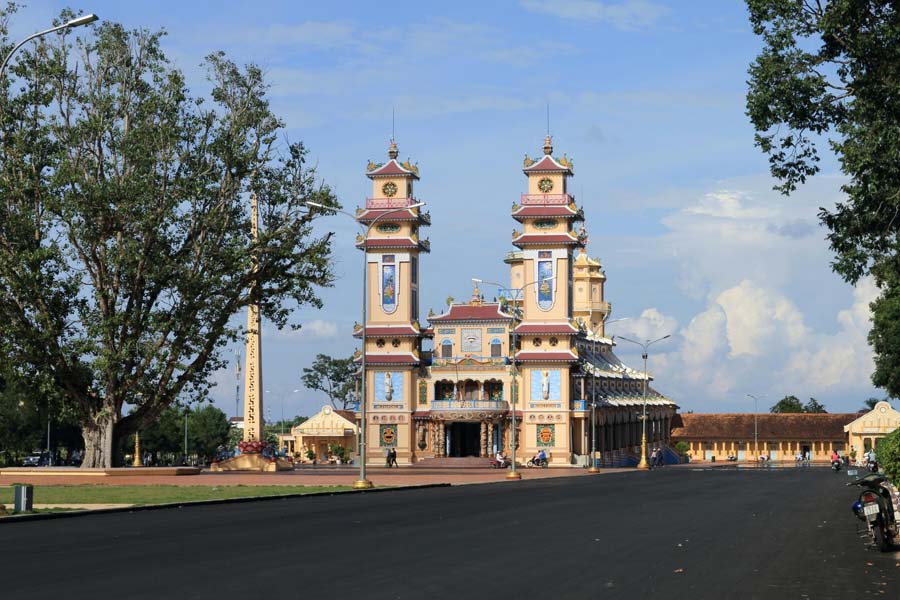
Caodaism or Caodai Temple in Tay ninh City
Caodaism was officially established in 1926 in Tay Ninh Province during the French colonial era, a period marked by profound social transformation, cultural dislocation, and spiritual uncertainty in southern Vietnam. Scholars of religion frequently interpret the rise of Caodaism as a response to the encounter between traditional Vietnamese cosmology and the expanding influence of Western modernity
The religion emerged within a complex intellectual environment shaped by:
Buddhism
Confucian philosophy
Taoist cosmology
Vietnamese folk religion
Hinduism
Catholic
Religious historians often describe Caodaism as a “syncretic universalist religion,” founded upon the principle that all spiritual traditions ultimately originate from the same divine source. This theological orientation is encapsulated in the Caodaist doctrine of Tam Giao Dong Nguyen “The Three Teachings Return to One”
One of the most controversial and academically fascinating aspects of early Caodaism was its extensive use of spirit – medium séances, known in Vietnamese as (cau cơ). Through these rituals, adherents believed they received divine revelations directly from God and enlightened spiritual entities. This practice has attracted significant attention from anthropologists, historians of mysticism, and scholars of comparative religion
Religious Syncretism and Spiritual Universality
One of the most extraordinary features of Caodaism is its inclusion of historical and literary figures within its sacred cosmology
Caodaist spiritual tradition venerates individuals or 3 prophets
Victor Hugo is from France, San Yat Sen is from China and Nguyen Binh Khiem is from Vietnam
These personalities are regarded not merely as historical figures but as enlightened spirits participating in humanity’s spiritual evolution during the “Third Era of Universal Salvation”. This theological inclusiveness has led many scholars to classify Caodaism as a rare example of global religious universalism emerging outside the Western intellectual tradition.
1954 – 1960: Reorganization and Expansion
Following the 1954 Geneva Accords, South Vietnam entered a period of political instability and intensifying conflict. In Cu Chi, revolutionary networks continued operating underground, literally and strategically. Existing tunnels were expanded, reinforced, and connected between villages. Life beneath the surface became increasingly organized. Fighters and civilians learned to survive underground for extended periods, conducting meetings, preparing supplies, and even treating wounded soldiers below ground. One of the most innovative developments was the famous “Hoang Cam stove,” an underground cooking system designed to disperse smoke through hidden vents, making it difficult for aircraft to detect human activity from above
By the late 1950s, sections of the tunnel complex had become multi-layered defensive systems reaching depths of more than eight meters
1961–1965: Escalation and the Rise of Guerrilla Strategy
As the Vietnam War escalated in the early 1960s, Cu Chi emerged as one of the most strategically important resistance zones near Saigon. Guerrilla fighters could launch attacks and disappear underground within minutes.
The military effectiveness of Cu Chi rested on three major principles:
Rather than engaging in conventional battles, guerrilla units relied on rapid movement, surprise attacks, and sudden withdrawal. The tunnels allowed fighters to evade air surveillance and ground patrols. The invisible nature of the underground network created enormous psychological pressure on opposing troops. Many American soldiers described Cu Chi as a “ghost battlefield,” where danger could emerge from beneath the earth without warning.
Civilian – Military Integration
The tunnel system functioned because of the close cooperation between local civilians and resistance fighters. Farmers cultivated crops above ground while supporting logistics and communications below it. This reflected the broader Vietnamese doctrine of “people’s war.” The tunnels were also protected by elaborate trap systems, hidden chambers, and false passages that demonstrated extraordinary tactical creativity despite limited resources
7h00 AM: Tour guide and driver will pick you up at your hotel and we will visit the Cuchi tunnel first
8h45 AM: Cuchi tunnel, you will have chance to go down the first level of the tunnel system
10h15 AM: We are going to the Caodai Temple, the main mass will be organized at 12 o’clock, we will spend 35 minutes inside, enjoy the Caodai religion mass service
12h35 PM: We will have lunch in downtown local restaurant
13h25 PM: We are going the Baden mountain, it was called black lady mountain, and we will take the cable car up to the roof top view, where we visit Sakyamuni buddha statue, it is more then 2 hours for staying up there
15h30 PM: We are going back to the Ho Chi Minh City and then you will have free time, we are arrival at the centre at 18:00 PM or 18:30 PM, it depends on the traffict at noon time
Includes
Excludes
| Group size | Price per group (VND) | Price per group (USD) |
| 1-2 persons | VND 7,600,000 | USD 290 |
| Extra person | VND 1,300,000 per person | USD 51 per person |



(+84) 814 639 113)
PdDTourhelp@gmail.com